

Doppler Ultrasound
Doppler Ultrasound
At Rahila Labs, we offer advanced Doppler and 3D/4D ultrasound services using modern imaging technology to deliver precise and reliable diagnostic results. Our comprehensive ultrasound services include routine and specialized studies such as fetal growth assessments, anomaly scans, fetal Doppler, and arterial and venous Doppler examinations. Interventional ultrasound-guided procedures are also performed by our experienced radiologists, ensuring accuracy and patient safety.
Ultrasound imaging uses high-frequency sound waves to produce detailed images of internal organs and blood flow. The introduction of real-time 3D and 4D imaging has significantly enhanced diagnostic clarity, allowing more accurate evaluations and better clinical decision-making.
What Is Ultrasound?
Ultrasound (also known as sonography) is a non-invasive, painless, and radiation-free imaging technique that uses sound waves to visualize internal body structures. It produces real-time images, called sonograms, which help assess organs, tissues, and blood flow.
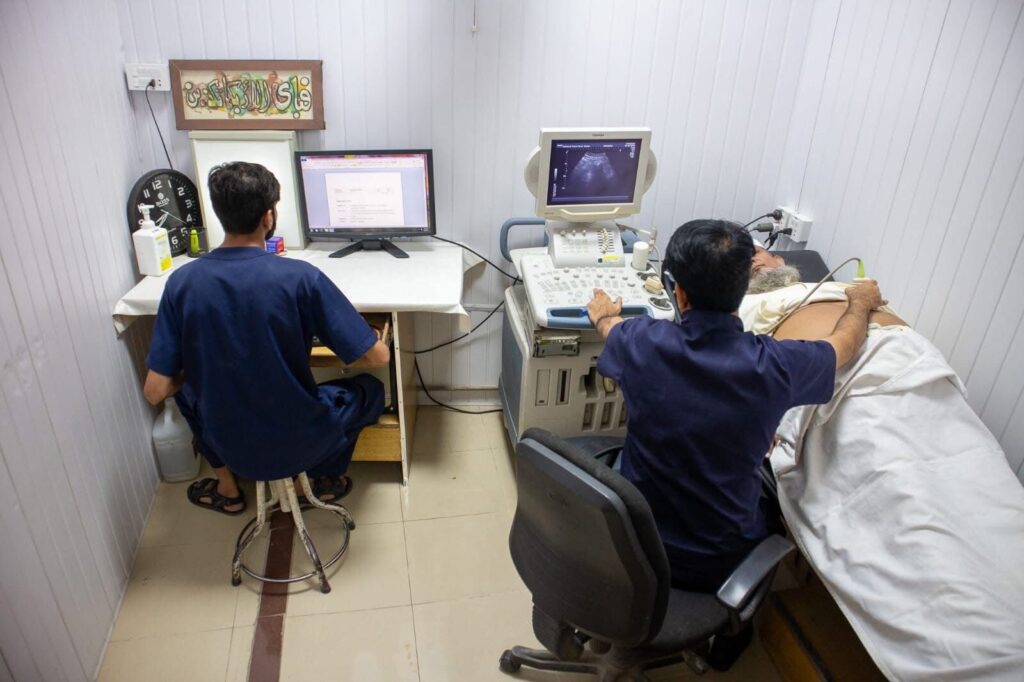
Doppler Ultrasound
Ultrasound Examinations That Do Not Require Preparation
The following ultrasound studies typically require no special preparation:
Axillary Ultrasound – Evaluates lymph nodes, often alongside breast imaging
Arterial Doppler (Upper/Lower Limbs) – Assesses reduced or blocked blood flow
Breast Ultrasound – Further evaluates areas of concern seen on mammography
Carotid Doppler – Examines blood flow in carotid arteries for narrowing or blockage
Non-Vascular Extremity Ultrasound – Detects soft tissue masses or lesions
Renal Ultrasound – Assesses kidneys for stones, cysts, or obstruction
Scrotal Ultrasound – Evaluates testicular pain, inflammation, or vascular issues
Soft Tissue Ultrasound – Detects infections, inflammation, or masses
Thyroid Ultrasound – Examines thyroid enlargement or nodules
Transvaginal Ultrasound – Evaluates pelvic organs for gynecological concerns
Venous Doppler (Upper/Lower Limbs) – Detects blood clots such as DVT
Ultrasound Examinations That Require Preparation
Proper preparation is essential for accurate imaging. If preparation guidelines are not followed, the examination may need to be rescheduled.
Abdominal & Right Upper Quadrant Ultrasound – Evaluates organs such as liver, gallbladder, pancreas, and spleen
Abdominal Aorta Ultrasound – Screens for abdominal aortic aneurysm (AAA)
Bladder Ultrasound – Assesses bladder volume, stones, and wall thickness
Obstetric (OB) Ultrasound – Monitors fetal development during pregnancy
Pelvic Ultrasound – Investigates pelvic pain, bleeding, or reproductive issues
Prostate Ultrasound – Evaluates prostate enlargement, inflammation, or cancer
Renal Artery Doppler – Assesses blood flow to the kidneys
Clinical Uses of Ultrasound
Ultrasound is commonly used to:
Monitor fetal growth and detect abnormalities during pregnancy
Diagnose conditions affecting the liver, gallbladder, pancreas, thyroid, kidneys, bladder, ovaries, testes, and breast
Evaluate blood flow in arteries and veins
Assist in ultrasound-guided procedures such as biopsies and fluid aspirations
Ultrasound During Pregnancy
Dating Scan (8–14 weeks): Determines gestational age and expected delivery date (EDD)
Anomaly Scan (18–21 weeks): Detects fetal structural abnormalities
4D Ultrasound: Provides real-time images of the fetus, often performed around the sixth month, allowing parents to see facial features and movements
Role of Ultrasound in Women’s Health
Ultrasound is a safe and primary diagnostic tool for evaluating various gynecological conditions, including:
Polycystic Ovary Syndrome (PCOS)
Fibroid uterus
Endometriosis
Ovarian cysts
Gynecological cancers of the uterus and ovaries
Please call Patient Services Department at
UAN # : (021) 34548236
Disclaimer: Every diagnostic test has scientific acceptable technology or technique based limitations of uncertainty of measurement, false positive or false negative and so do not fall under the domain of negligence. In case of any such scenario, we offer free repeat of test within 24-48 hours.